Translate

Tuesday, 2 June 2015

June will be one second longer this year

June will be one second longer this year

http://umangspaceencyclopedia.blogspot.in/

If your birthday falls on June 30, you can celebrate for a wee bit longer this year!
The last day of June this year will get an extra second after the Paris Observatory announced it was adding a leap second to clocks.
Dials will read 11:59:60 on June 30 as clocks hold their breath for a second to allow the Earth's rotation to catch up with atomic time, experts said.
Atomic time is constant, but the Earth's rotation is gradually slowing down by around two thousandths of a second per day.
Scientists at the International Earth Rotation Service in France monitor the Earth's rotation and tweak time where necessary.
Software companies are already bracing themselves for problems. When the last leap second was added in 2012, several companies reported crashes and there were also problems with programmes written in Java, the Telegraph reported.
"The Earth is slowing down a little bit," said Nick Stamatakos, the chief of Earth Orientation Parameters at the US Naval Observatory.
"They add an extra second to something called UTC (Coordinated Universal Time) in order to make sure the rate of UTC is the same as atomic time," Stamatakos said.
The first leap second was added in 1972, and it will be the 26th time it has been added to clocks in history.
Adding the leap second will mean that at 11:59:59pm on June 30 for one second clocks will read 11:59:60 pm.
"For that day [June 30] there'll be 86,401 seconds, instead of 86,400 seconds. The length of the day for you and I and everyone on the Earth will have an extra second," Stamatakos added.


Thursday, 14 May 2015

આર્ટિસ્ટે દોડાવ્યા કલ્પનાઓનાં ઘોડાપૂર, આવું હોઇ શકે છે મંગળ પર જીવન


આર્ટિસ્ટે દોડાવ્યા કલ્પનાઓનાં ઘોડાપૂર, આવું હોઇ શકે છે મંગળ પર જીવન

અજબ-ગજબ ડેસ્ક: વૈજ્ઞાનિકોને મંગળ ગ્રહ પર પહોંચવામાં ભલે હજી અમુક વર્ષો લાગે. પરંતુ એક સ્વિડિશ આર્ટિસ્ટે મંગળ ગ્રહ પર ભાવિ જીવનની અમુક તસવીરો તૈયાર કરી છે. જે જોઇને ભવિષ્યમાં ત્યાં માણસો કેવી રીતે રહેશે તેનો અંદાજો લગાવી શકાય છે. આર્ટિસ્ટ વિલે એરિક્સન પ્રમાણે ત્યાં ડોમ જેવી એક સરંચના અને અમુક કોલોનીઓ બનેલી હશે, જ્યાં લોકો રહેશે. આ ડોમની અંજર જ શાકભાજી અને ફળો ઉગશે. જોકે એ વાત જાણી શકાય નથી કે વિલેની આ તસવીરો પાછળ તેમણે કેટલા વૈજ્ઞાનિક વિચારોને ધ્યાનમાં રાખ્યા છે. જોકે આ એક શરૂઆત કહી શકાય અને ભવિષ્યમાં આપણને મંગળ પરનાં ભાવિ જીવન સંબંધિત વધુ તસવીરો જોવા મળી શકે છે. જેમાંથી ઘણી હકિકત પણ બની શકે છે.

http://umangspaceencyclopedia.blogspot.in


(એક સ્વિડિશ આર્ટિસ્ટે ભાવિ મંગળની તૈયાર કરેલી તસવીરો)
આર્ટિસ્ટે દોડાવ્યા કલ્પનાઓનાં ઘોડાપૂર, આવું હોઇ શકે છે મંગળ પર જીવનઆર્ટિસ્ટે દોડાવ્યા કલ્પનાઓનાં ઘોડાપૂર, આવું હોઇ શકે છે મંગળ પર જીવનઆર્ટિસ્ટે દોડાવ્યા કલ્પનાઓનાં ઘોડાપૂર, આવું હોઇ શકે છે મંગળ પર જીવનઆર્ટિસ્ટે દોડાવ્યા કલ્પનાઓનાં ઘોડાપૂર, આવું હોઇ શકે છે મંગળ પર જીવન
આર્ટિસ્ટે દોડાવ્યા કલ્પનાઓનાં ઘોડાપૂર, આવું હોઇ શકે છે મંગળ પર જીવન
Source - DivyaBhaskar

Thursday, 29 January 2015

મિશન માર્સ : મંગળ ગ્રહ પર સામાન્ય માણસ

મિશન માર્સ : મંગળ ગ્રહ પર સામાન્ય માણસ
http://umangspaceencyclopedia.blogspot.in/


એક નિર્જીવ અને સુદૂર દુનિયાની યાત્રા જેના માટે તમારે તમારું ઘર જ નહીં પણ આખી પૃથ્નીને અલવિદા કહીને જવાનું. ૨૨.૫ કરોડ કિલોમીટરની યાત્રા જેની કોઇ રિટર્ન ટિકિટ નથી. મુશ્કેલ અને અશક્ય લાગતી આ યાત્રા માટે પણ લગભગ બે લાખ લોકોએ તેમનું નામ નોંધાવ્યું છે. પોતાના ખર્ચે મંગળ ગ્રહ પર જવાની આ યાત્રાનું આયોજન નેધરલેન્ડની માર્સ વન નામની સંસ્થા કરી રહી છે. આ સંસ્થાનું કહેવું છે કેઆ યાત્રા માટે તમારે દિલથી નિર્ણય કરવો પડે. આ યુદ્ધભૂમિ પર રિર્પોિંટગ કરવા જેવું સાહસિક છે. નોનપ્રોફિટ સંગઠન ધન એકત્રિત કરીને આગામી દસ વર્ષમાં યાન બનાવી મંગળ પર પ્રથમ પૃથ્વીવાસીઓની કોલોની બનાવવાનું આયોજન કરી રહી છે. આ સંસ્થા મંગળ પર લઇ જવા માટેનાં લોકોની ચિકિત્સા કરશે. આ માટે તેમણે વીસ વર્ષ સુધી વિવિધ અવકાશી એજન્સીઓમાં રહી ચૂકેલા નિષ્ણાત ક્રાફ્ટની નિમણૂક કરી છે. ક્રાફ્ટે અવકાશમાં લાંબો સમય રહેવાની સંભાવનાઓ પર પણ સંશોધન કર્યું છે. તેમનું કહેવું છે કેહવે મારી શોધોને હકીકતમાં બદલવાનો સમય આવી ગયો છેપરંતુ બે લાખ લોકોમાંથી ક્રાફ્ટ અવકાશમાં જનાર લોકોની પસંદગી કઇ રીતે કરશે. આ માટે તે કહે છે કેએ માટે હું તૈયાર છું જ્યારે તેઓ મંગળ પર પહોંચશે ત્યારે તેમને સ્વર્ગ જેવી અનુભૂતિ થશે તો જોઇએ ક્રાફ્ટ કોને અવકાશમાં લઇ જવા માગે છે.
પ્રથમ ચરણઃ શારીરિક
અંતરિક્ષ યાત્રીઓની પસંદગીનું પ્રથમ ચરણ એ શારીરિક છે. આમાંથી જેને કોઇ અસાધ્ય રોગ હોય તેવા તમામને બાકાત કરવામાં આવશે. શારીરિક રીતે ફિટ હોય તેને જ પસંદ કરવામાં આવશે. સૌપ્રથમ મંગળ પર પહોંચનારા બાબતે સંસ્થા ખૂબ સંવેદનશીલ છે જ્યારે ત્યાં વસતી વધશે પછી આ શારીરિક માપદંડમાં છૂટછાટ અપાશે. આ યાત્રા માટેની ચિકિત્સા સામાન્ય અવકાશયાત્રીઓ જેવી જ હશે. તેમણે જે તે તબીબો પાસેથી પ્રમાણપત્રો લેવાં પડશે. આ કાર્યક્રમમાં ઉંમરની કોઇ સીમા નથી પરંતુ સામાન્ય રીતે આ કાર્યક્રમ માટે સૌૈથી ફિટ લોકો ત્રીસથી ચાલીસની વય વચ્ચેના હતા.
બીજું ચરણઃ જ્ઞાાન
પ્રથમ ચરણ બાદનું બીજું ચરણ છે મુલાકાત. આ ચરણ સુધી છસોથી વધારે ઉમેદવારો પહોંચી ગયા છે. આ ઉમેદવારોના હવે ઇન્ટરવ્યૂ ચાલી રહ્યા છેજોકે આ મિશન પર જવા માટે કોઇ ચોક્કસ ડિગ્રી કે ભણતરની જરૂર નથી. પરંતુ મંગળને લઇને જિજ્ઞાાસા અને તેને લગતી બાબતોને શીખવાની ધગશ જોવામાં આવે છે. આ ઉપરાંત તેમને એ પણ ખ્યાલ હોવો જોઇએ કે તેઓ શું કરવા જઇ રહ્યા છે. તેમની પાસેથી ટીમના સારા સભ્ય બનીને યાત્રા પૂરી કરવાની યોગ્યતા છે કે નહીંં તે જોવામાં આવે છે. દરેક ઉમેદવારોને આ પ્રમાણે નંબર આપવામાં આવશે. કારણ કે બધાને લઇ જવા શક્ય નથી.
ત્રીજું ચરણઃ ટીમ સ્પિરિટ
મંગળ પરના સફળ મિશન માટે એવા લોકોની જરૂર છે કે જેઓ ભેગા થઇને ટીમ બનાવી શાંત ચિત્તે યાત્રા પૂરી કરી શકે. ઉપરાંત જીવના જોખમની ઘડીઓમાં પણ ટીમ બનીને કામ કરેઆમ પણ પૃથ્વી પરથી કોઇ પણ જવાબ તેમને ચાલીસ મિનિટ બાદ જ મળશે. માટે કેટલાક નિર્ણયો તેમણે જાતે જ કરવા પડશેઆ ઉપરાંત મંગળ પર સ્થાયી નિવાસ બનાવનારી ટીમોને પણ બોલાવી તેમની પસંદગી કરવામાં આવશે. આમ આ મિશન માટે કોઇ પરફેક્ટ અવકાશયાત્રી કરતાં વધારે ટીમ સ્પિરિટથી કામ કરતા એક આખા સમૂહ વધારે મહત્ત્વનો છેમાટે આ પસંદગીમાં ટીમ સ્પિરિટ અગત્યનો છે.
ચોથું ચરણઃ અલગાવ
સંભવિત અંતરિક્ષયાત્રીઓેને ભેગા કરીને એક નકલી અંતરિક્ષયાનમાં બેસાડી તેમને કેટલાક સપ્તાહ સુધી રાખવામાં આવે જેથી તેઓ પર આ યાત્રાની શું અસર થાય છે તે જોઇ શકાય. આવો જ એક પ્રયોગ મોસ્કોનાં ઉપનગરમાં થયો હતો. જેમાં ૫૨૦ દિવસ સુધી નકલી અંતરિક્ષયાનમાં બંધ કરીને અવકાશયાત્રીઓને મંગળ મિશનની ચુનૌતિઓથી વાકેફ કરવામાં આવ્યા હતા. આ પ્રકારનો પ્રયોગ ઉમેદવારોમાં રહેલી ખૂબીઓ અને ખરાબીને સામે લાવશે. રુસનાંં એક પ્રયોગમાં તેમાં ગયેલા બધા અસફળ રહ્યા હતા. જો તમે ચાલબાજી કરશો તો આ પરિસ્થિતિમાં નહીં ટકી શકો.
પાંચમું ચરણઃ સઘનું પ્રશિક્ષણ
જો આ યોજના આ ઝડપે ચાલુ રહેશે તો આગામી સમયમાં આ ટુકડીઓને અવકાશયાન ચલાવવાથી લઇને મંગળ પર કઇ રીતે રહેવું તેનું પ્રશિક્ષણ આપવામાં દસ વર્ષ જેટલો સમય લાગશેજો આ યોજના અસફળ પણ રહેશે તો તે અંતરિક્ષ વિજ્ઞાાનનાં વિકાસ માટે મહત્ત્વની બની રહેશે. આ યોજનામાં કોણ  મંગળ પર જશે તે બાબતે કોઇ ગેરંટી નથી. એવું પણ બને આ તમામમાંથી કોઇ પણ મંગળ પર જવા માટેની પ્રથમ ટુકડીમાં પસંદ ના પણ થાય. તેમ છતાં મહત્ત્વાકાંક્ષી આ યોજનાએ હાલમાં તો લોકોનું ધ્યાન તેના તરફ ખેચ્યું છે.


Thursday, 15 January 2015

Strange Facts

 Strange Facts

http://umangspaceencyclopedia.blogspot.in/


પૃથ્વી તેની ધરી પર કલાકના 1,000 માઈલની ઝડપે ફરે છે જ્યારે અવકાશમાં તે કલાકના 67,000 માઈલની ગતિએ ફરે છે

એક વીજળી બોલ્ટ સૂર્યની સપાટીની ગરમી કરતા પાંચ ઘણી ગરમી પેદા કરે છે.

અમેરિકન ખગોળશાસ્ત્રી એડવિન હબલના નામ પરથી ટેલિસ્કોપનું નામ હબલ રાખવામાં આવ્યું છે.

શનિ ગ્રહની ઘનતા એટલી ઓછી છે કે તે પાણીમાં પણ તરી શકે છે.

આરસીડબલ્યુ સુપરનોવા ૯,૧૦૦ પ્રકાશવર્ષનું અંતર ધરાવે છે.

નાસાના સ્પિત્ઝર સ્પેસ ટેલિસ્કોપ દ્વારા સુપરનોવા વિશે માહિતી મેળવી શકાઈ છે.

ઈ.સ. પૂર્વે ૧૮૫માં આરસીડબલ્યુ સુપરનોવા નોંધવામાં આવ્યો હતો.

જ્હોન ગ્લેન પહેલા અમેરિકન હતા જેમણે પૃથ્વીની પરિક્રમા કરી હતી.

રોમન સાહિત્યમાં પણ આરસીડબલ્યુ ઉલ્લેખ જોવા મળે છે.

આરસીડબલ્યુ સુપરનોવાને ગેસ્ટ સ્ટાર તરીકે પણ ઓળખવામાં આવે છે.

આરસીડબલ્યુ ૮૬ને એસએન ૧૮૫ સુપરનોવા તરીકે પણ ઓળખવામાં આવે છે.

સૂર્ય દસ કરોડ વર્ષમાં જેટલી ઊર્જા ઉત્પન્ન કરે છે એટલી ઊર્જા સુપરનોવાનો ધડાકો દસ સેકન્ડમાં ઉત્પન્ન કરે છે.

પ્લુટો ગ્રહનો એક દિવસ પૃથ્વીના સાત દિવસ જેટલો લાંબો હોય છે.

રશિયાના વેલેન્ટિના ટેરેશ્કોવા પ્રથમ મહિલા અવકાશયાત્રી હતા.

યુએફઓનો ઉલ્લેખ બાઈબલમાં પણ જોવા મળે છે.

બુધ ગ્રહ મંગળ કરતાં ભારે છે અને પૃથ્વી જેટલું જ વજન ધરાવે છે.

સૌર મંડળમાં સૂર્યની નજીક હોવાના કારણે બુધ પર દિવસ દરમિયાન તાપમાન ૭૫૦ ડિગ્રી ફેરનહીટ સુધી પહોંચી જતું હોય છે.

અવકાશમાં પહેલો ઉંદર ૧૯૬૧માં ફ્રાન્સ દ્વારા મોકલવામાં આવ્યો હતો.

Sunday, 4 January 2015

જૂનમાં ગ્રહણને કારણે પંદર દિવસ માટે મંગળયાન સાથેનો સંપર્ક ઠપ થશે

જૂનમાં ગ્રહણને કારણે પંદર દિવસ માટે મંગળયાન સાથેનો સંપર્ક ઠપ થશે

http://umangspaceencyclopedia.blogspot.in/


સૂર્ય ૮ જૂનથી ૨૨ જૂન સુધી પૃથ્વી અને મંગળ ગ્રહની વચ્ચે આવશે


આગામી આઠમી જૂનથી બાવીસમી જૂન દરમિયાન સૂર્ય પૃથ્વી અને મંગળગ્રહની વચ્ચે આવી જશે. આમ તો આ એક સામાન્ય ખગોળશાસ્ત્રીય ઘટના છે. પરંતુ આ ઘટનાને કારણે ઈસરોના વૈજ્ઞાાનિકોની નીંદર હરામ થઈ જશે. આ પંદર દિવસ દરમિયાન ભારતના મંગળયાન અને ઈસરોની ટીમ વચ્ચે કોઈ પણ સંદેશાઓનું આદાનપ્રદાન શક્ય નહીં બને.
ઈસરોના ભૂતપૂર્વ અધ્યક્ષ કે રાધાકૃષ્ણે આ અંગે માહિતી આપતા કહ્યું હતું કે ૨૦૧૩ની પાંચમી નવેમ્બરના મંગળયાનના અંતરિક્ષ પ્રયાણ બાદ આવુ પહેલી વખત બનશે કે મંગળયાન તથા ઈસરો ટીમ વચ્ચે કોઈ પણ પ્રકારનો સંપર્ક શક્ય નહીં બને.
ગ્રહણને કારણે થનારા આ બ્લેક આઉટ પિરીયડમાં મંગળયાને પાઠવેલાકોઈ પણ સંદેશા ઈસરો ખાતે પહોંચશે નહીં અને ઈસરોની ટીમ પણ કોઈ પણ પ્રકારના સંદેશા કે સૂચના મંગળયાનને પાઠવી નહીં શકે.
જો કે મંગળયાનના પ્રોજેક્ટ ડાયરેક્ટર સુબૈયા અરુનને કહ્યું હતું કે મંગળયાનની જમીન પર થયેલા વિવિધ પરિક્ષણો દરમિયાન આ બાબતને પણ આવરી લેવામાં આવી હતી. અરુનને કહ્યું હતું કે મંગળયાન અંતરિક્ષમાં પહોંચ્યા પછી એવા કેટલાક પ્રસંગો બન્યા હતા. જ્યારે કોઈ પણ પ્રકારનું  પ્રત્યાયન શક્ય ન હતું. પરંતુ આવુ પહેલી વાર બનશે કે જ્યારે પંદર દિવસ માટે કોમ્યુનિકેશન ખોરવાઈ જશે. ૨૦૧૬માં મે મહિનામાં પૃથ્વી ગ્રહ સૂર્ય અને મંગળગ્રહની વચ્ચે આવી જશે અને ત્યારે પણ લગભગ પંદર દિવસ માટે આ પ્રકારની પરિસ્થિતી સર્જાવાની છે એવી માહિતી તેમણે આપી હતી.


Thursday, 1 January 2015

Dawn begins final approach to dwarf planet Ceres

Dawn begins final approach to dwarf planet Ceres

http://umangspaceencyclopedia.blogspot.in/


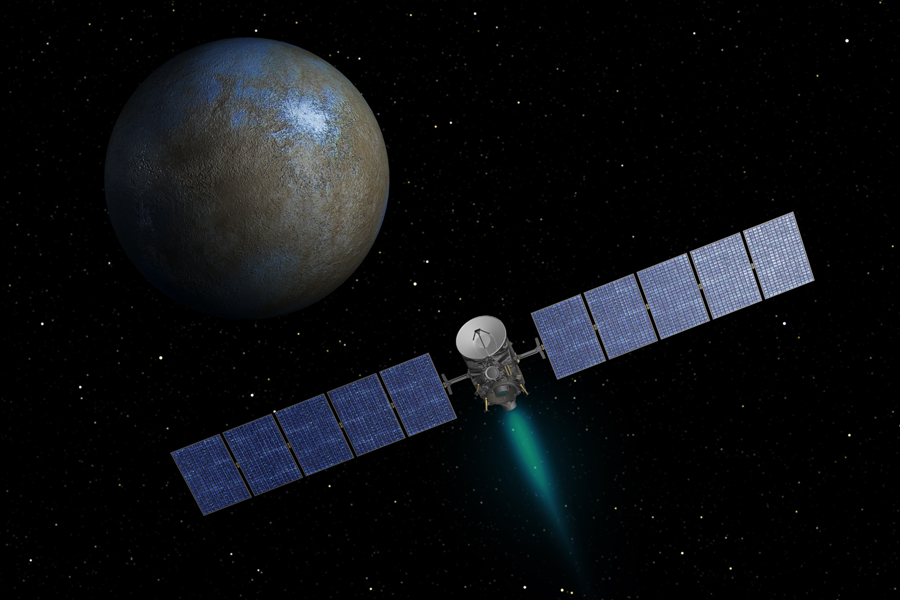
Artist's concept of the Dawn spacecraft firing its ion propulsion system on approach to Ceres. Credit: NASA/JPL-Caltech

Artist’s concept of the Dawn spacecraft firing its ion propulsion system on
approach to Ceres. Credit: NASA/JPL-Caltech

NASA’s Dawn spacecraft has begun its final approach to the dwarf planet Ceres, the largest object in the asteroid belt, for an in-depth survey of the uncharted world.
The solar-powered space probe is scheduled to arrive at Ceres in March, when the Texas-sized world’s gravity will capture Dawn in orbit. With the help of its electrically-powered ion propulsion system, Dawn will reach a circular orbit 8,400 miles from Ceres by late April.
Seven years into its mission, Dawn is on an interplanetary sojourn to visit two of the solar system’s most massive asteroids. After launching from Earth in September 2007, Dawn orbited asteroid Vesta from July 2011 to September 2012, when it started a nearly three-year journey to Ceres.
Dawn will become the first spacecraft to orbit two extraterrestrial objects when it arrives at Ceres in March.
Such a journey would not be possible without Dawn’s three ion engines, which combine electrical power and xenon gas to generate modest levels of thrust.
Conventional thrusters fueled by chemical propellants provide a greater push, but ion thrusters are more efficient. By firing the less powerful ion thrusters for months at a time, Dawn is reshaping its trajectory through the solar system in ways chemically-powered spacecraft could not achieve.
Dawn’s ion thrusting was interrupted for four days in September when the probe was blasted by a high-energy particle of cosmic radiation, temporarily knocking the propulsion system offline.
Interplanetary navigators based at NASA’s Jet Propulsion Laboratory plotted a new course for Dawn to reach Ceres on almost the same schedule as planned before the craft was hit by a blitz of cosmic rays.
Under the new plan, Dawn will be snared by the gravitational tug of Ceres on March 6. But instead of Ceres pulling the probe directly into orbit 8,400 miles from the dwarf planet, Dawn will fly out in front of Ceres before its gravity — working together with continued thrusting from Dawn’s ion engines — gently captures the spacecraft.
The maneuver will be done without the need for a large conventional rocket burn performed on missions arriving at Mars or other planets.
By April 23, Dawn will be in its initial 8,400-mile-high orbit around Ceres, according to a blog post by Marc Rayman, the mission’s chief engineer.
As of Dec. 29, Dawn was about 400,000 miles from Ceres and closing in at around 450 mph, according to a JPL press release.
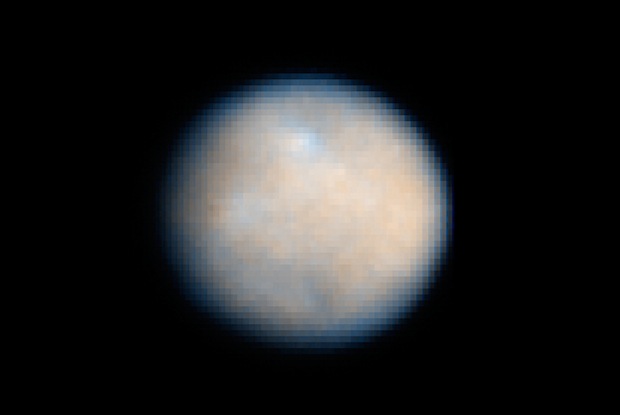
A view of Ceres from the Hubble Space Telescope. Credit: NASA/ESA/J. Parker (Southwest Research Institute)

A view of Ceres from the Hubble Space Telescope.
Credit: NASA/ESA/J. Parker (Southwest Research Institute)

Dawn will survey Ceres from a series of different altitudes, measuring the world’s composition, internal structure, and surface characteristics.
Scientists believe Ceres formed like the rest of the solar system’s planets, but it failed to collect enough material to build up size. It measures nearly 600 miles across and has a spherical shape, according to imagery of Ceres taken by the Hubble Space Telescope.
Ceres is very different from Vesta — Dawn’s first destination — which is rocky, covered in ancient impact craters, and has an irregular shape. Scientists say Ceres is covered in ice and may even harbor and underground ocean of liquid water.
But the full picture of Ceres will not be known until Dawn’s arrival. By the end of January, Dawn’s camera will begin taking better images of Ceres than possible with Hubble.
“Ceres is almost a complete mystery to us,” said Christopher Russell, principal investigator for the Dawn mission from the University of California, Los Angeles. “Ceres, unlike Vesta, has no meteorites linked to it to help reveal its secrets. All we can predict with confidence is that we will be surprised.”

Wednesday, 31 December 2014

Get ready for Comet Lovejoy!

Get ready for Comet Lovejoy!

http://umangspaceencyclopedia.blogspot.in/

Comet C/2014 Q2 (Lovejoy) seen here on the border of constellations Columba and Lepus, late December 2014. Image credit: Paul Stewart of Timaru, New Zealand using a WO FLT 132 refractor with 0.8x reducer/flattener and a QSI 583wsg camera. Licensed under CC BY-SA 2.0 via Wikimedia Commons.
Comet C/2014 Q2 (Lovejoy) seen here on the border of constellations
Columba and Lepus, late December 2014. Image credit: Paul Stewart 
of Timaru, New Zealand using a WO FLT 132 refractor with 0.8x
reducer/flattener and a QSI 583wsg camera. Licensed under CC 

Those of you who received a pair of binoculars or a telescope for Christmas hoping that something interesting and unusual to view might come along have just had your prayers answered, for it’s now open season for C/2014 Q2 — better known as simply Comet Lovejoy — set to become the first bright and hopefully naked-eye comet of 2015. The fifth comet discovery of Australian amateur astronomer Terry Lovejoy using an 8-inch wide-field telescope on 17th August 2014, it quickly became apparent that this was a long-period comet, but not its first visit to the Sun.
C/2014 Q2 (Lovejoy) had an orbital period of ~11500 years prior to entering the inner Solar System where planetary perturbations have now reduced it to ~8000 years. The comet is closest to the Earth on 7th January 2015 at a distance of 44 million miles (70 million kilometres) when it will be about its brightest. Perihelion (closest to the Sun) occurs on 30th January 2015. Click the graphic to open an interactive Java applet. Image credit: NASA JPL Small-Body Database Browser/Osamu Ajiki/Ron Baalke/Ade Ashford
C/2014 Q2 (Lovejoy) had an orbital period of ~11500 years prior
to entering the inner Solar System where planetary perturbations
have now reduced it to ~8000 years. The comet passes closest
to the Earth on 7th January 2015 when it will be about its brightest.
Perihelion (closest to the Sun) occurs on 30th January 2015. Click
the graphic to open an interactive Java applet. Image credit: NASA
JPL Small-Body Database Browser/Osamu Ajiki/Ron Baalke/Ade 
Ashford With a high orbital inclination of 80°, Comet Lovejoy is
approaching the ecliptic from below which has favoured Southern
Hemisphere observers until now, but that’s all about to change as
the comet rapidly heads north.

As 2014 draws to a close, C/2014 Q2 Lovejoy is already shining at magnitude +5 and lies in the constellation of Lepus the Hare, culminating at an altitude of about 15° by 10:30pm for UK-based observers — but conditions are set to improve rapidly as it heads north. Lovejoy should be brightest around 7th January when closest to the Earth, by which time the waning gibbous Moon brings the promise of darker skies. Image credit: AN graphic by Greg Smye-Rumsby

As 2014 draws to a close, C/2014 Q2 Lovejoy is already shining at magnitude
+5 and lies in theconstellation of Lepus the Hare, culminating at an altitude of
about 15° by 10:30 pm for UK-based observers — but conditions are set to
improve rapidly as it heads north at a rate of about 2° per day. 

Image credit: AN graphic by Greg Smye-Rumsby

The waxing gibbous Moon is currently interfering with observation of the comet, but binocular observers with an unobstructed view of a southern horizon that’s also free of light pollution should scan southern Lepus about 15° below Rigel in Orion around 10:30 pm to stand a good chance of viewing the diffuse puffball glow of C/2014 Q2. Currently at magnitude +5 (or brighter) it should still be obvious in moonlight, particularly in a telescope. While numerous astroimages show Comet Lovejoy sporting a thin ion tail about 5° long, the visual impression is that of a slightly asymmetric ball concentrated towards the centre. That was how it appeared in my 10×50 binoculars at 10 pm GMT on 29th December.
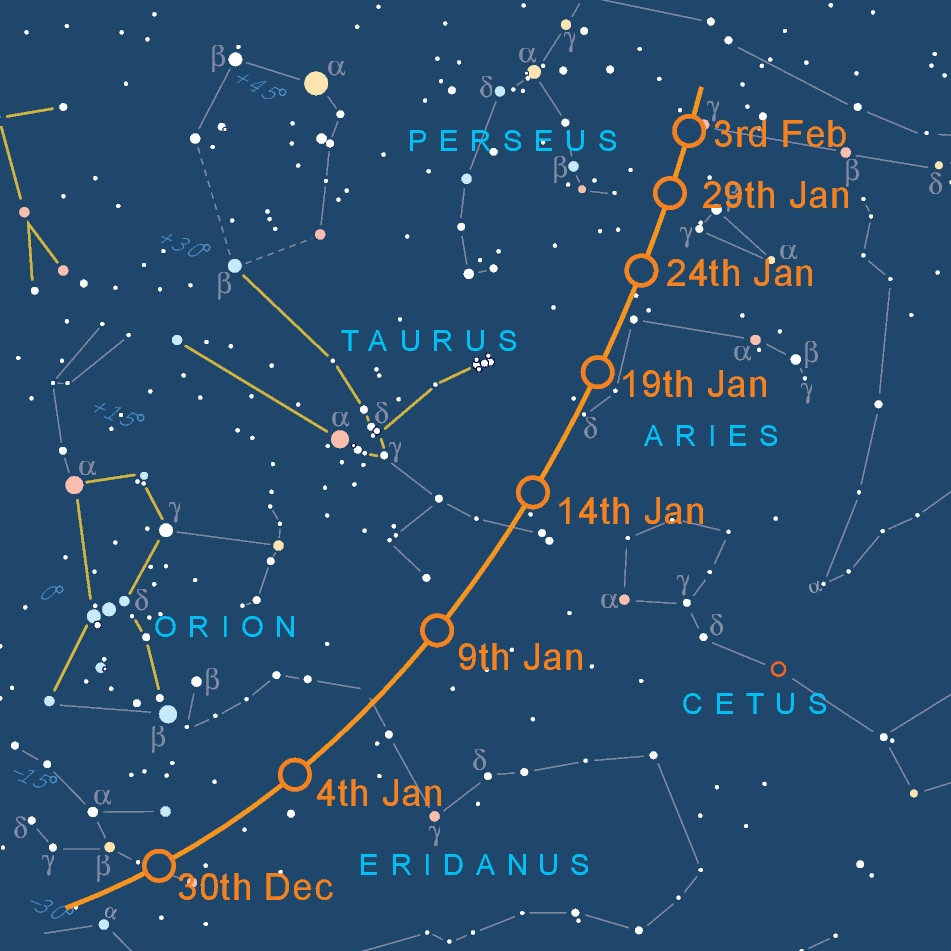
As the nights pass, Comet Lovejoy heads north-northwest, passing into the constellation of Eridanus in early January. By the night of Full Moon on 5th January, the comet will be 11° directly west (right) of Rigel, much higher in the sky and easily identifiable despite the Moon’s glow in Gemini.

Comet Lovejoy at its best

With the waning gibbous Moon (you can check the rise/set times with our Almanac) comes the best part of this cometary apparition. C/2014 Q2 makes its closest approach to the Earth on 7th January 2015 at 0.469 Astronomical Units (43.6 million miles; 70.2 million kilometres).
Comet Lovejoy crosses the celestial equator on 9th January 2015 and moves into Taurus — hopefully a comfortable naked-eye object by now — before passing into Aries on January 16th. A nice wide-angle astrophoto opportunity occurs on January 18th when C/2014 Q2 passes about 9° from the Pleiades.
With New Moon occurring on 20th January we have to be mindful of the returning lunar glow and Comet Lovejoy moves into the constellation of Triangulum on the 25th. The comet reaches perihelion on 30th January 2015 at a distance of 1.29 AU (120 million miles; 193 million kilometres) from the Sun, by which time we will see C/2014 Q2 heading for a close conjunction with beautiful double star Almach (gamma Andromedae) on 4th February.
For observers with equatorially-mounted telescopes or GoTo instruments, the table below lists the daily J2000 Epoch coordinates of right ascension (R.A.) and declination (Decl.) for Comet Lovejoy at Oh UT throughout the brightest part of the comet’s visibility. The column labelled Delta is the comet’s distance from the Earth in Astronomical Units (1 AU = 92.9 million miles or 149.6 million kilometres), while r is the comet’s distance from the Sun, also in AU

 C2014Q2_ephemeris_514x654

Tuesday, 30 December 2014

दुनिया की सबसे बड़ी दूरबीन बनायेगा भारत

दुनिया की सबसे बड़ी दूरबीन बनायेगा भारत
umangspaceencyclopedia.blogspot.com
नई दिल्ली। भारत के वैज्ञानिको ने दुनिया के सबसे सस्ते और पहले ही प्रयास में सफल मंगल मिशन के बाद संपूर्ण विज्ञान जगत को स्तब्ध कर दिया है। इस सफलता के बाद देश को जल्द ही एक और गौरवमयी उपलब्धि देने का फैसला किया है। भारतीय वैज्ञानिक दुनिया की सबसे बड़ी दूरबीन बनाने जा रहा है।

 दुनिया की सबसे बड़ी दूरबीन बनायेगा भारत

दुनियाभर के देशों को अपने मंगल अभियान की सफलता से चौंका देने वाला भारत विश्व के चार प्रतिष्ठित देशों के साथ मिलकर इस परियोजना पर काम करेगा। जापान के एक दैनिक समाचार पत्र के अनुसार इस अभियान में भारत का साथ देने वाले पांचों देश एक-साथ मिलकर हवाई द्वीप पर इस दूरबीन परियोजना पर काम करेंगे और जल्‍द से जल्‍द इसे पूरा करने की कोशिश करेंगे। सूत्रों की माने तो विश्‍व की इस सबसे बड़ी दूरबीन की लम्बाई करीब 30 मीटर होगी, जो लगभग 8 मंजिला इमारत जितनी ऊंची होगी। इसके साथ ही इस दूरबीन को ‘टीएमटी' के नाम से पुकारा जाएगा। इस दूरबीन के निर्माण कार्य में लंबा समय लग सकता है। वैज्ञानिकों की मानें तो इस दूरबीन का निर्माण 2022 तक पूरा हो हो जाएगा। इस परियोजना के आरंभ होने के मौके पर दुनियाभर की करीब 100 प्रतिष्ठित हस्तियां इसके आयोजन में शिरकत करेंगी, जिनमें अंतरिक्ष यात्री और परियोजना से जुड़े आला अधिकारी भी अपनी मौजूद रहेंगे। एक अनुमान के मुताबिक इस परियोजना पर 1.47 अरब डॉलर का खर्च होगा, जिसका 25 फीसदी खर्च जापान उठा रहा है। देश की सबसे बड़ी दूरबीन बनाने की भारत की इस परियोजना पर भारत अकेले काम नहीं कर रहा, बल्कि विश्व के कई प्रतिष्ठित देश भी भारत के साथ मिलकर इसपर काम करेंगे। इस दौरान भारत के साथ जापान, चीन, कनाडा औऱ अमेरिका भी शामिल रहेंगे और भारत को आगे बढ़ने में हर कदम पर उसका साथ देंगे। ऐसे में सभी देशों को मिलकर एक साथ मेहनत से काम करना होगा।

भारत के लिये मंगलयान ने बनाया 2014 को यादगार

 भारत के लिये मंगलयान ने बनाया 2014 को यादगार

 http://umangspaceencyclopedia.blogspot.in/


अमेरिका की प्रतिष्ठित पत्रिका टाइम ने भारत के मंगलयान को साल 2014 के सर्वश्रेष्ठ आविष्कारों में शामिल किया और भारत के पहले अंतरग्रहीय अभियान को द सुपरमार्ट स्पेसक्राफ्ट की संज्ञा दी, पत्रिका ने कहा कि कोई भी मंगल ग्रह पर पहली कोशिश में नहीं पहुंचा, जो काम अमेरिका, रूस और यूरोपीय देश नहीं कर पाये वह भारत ने कर दिखाया.और साल का अंत आते-आते जीएसएलवी मार्क का सफल प्रक्षेपण कर अंतरिक्ष में मानव अभियान भेजने की लोगों की उम्मीदों पर पंख लगा दिये,भारतीय अंतरिक्ष अनुसंधान संगठन ने वैसे तो इस वर्ष कई उपग्रहों का सफल प्रक्षेपण किया लेकिन उसकी उपलब्धियों के ताज में सबसे अहम रहा पहले ही प्रयास में मंगलयान को लाल ग्रह की कक्षा में स्थापित करना और देश के सबसे भारी राकेट जीएसएलवी मार्क के जरिए मानवरहित माडयूल का सफल परीक्षण.